
There is something distinctly addictive about driving through the Western Ghats when the skies open up. The tarmac turns glossy black, low-hanging clouds swallow the ridgelines, and every small roadside stream swells with life.
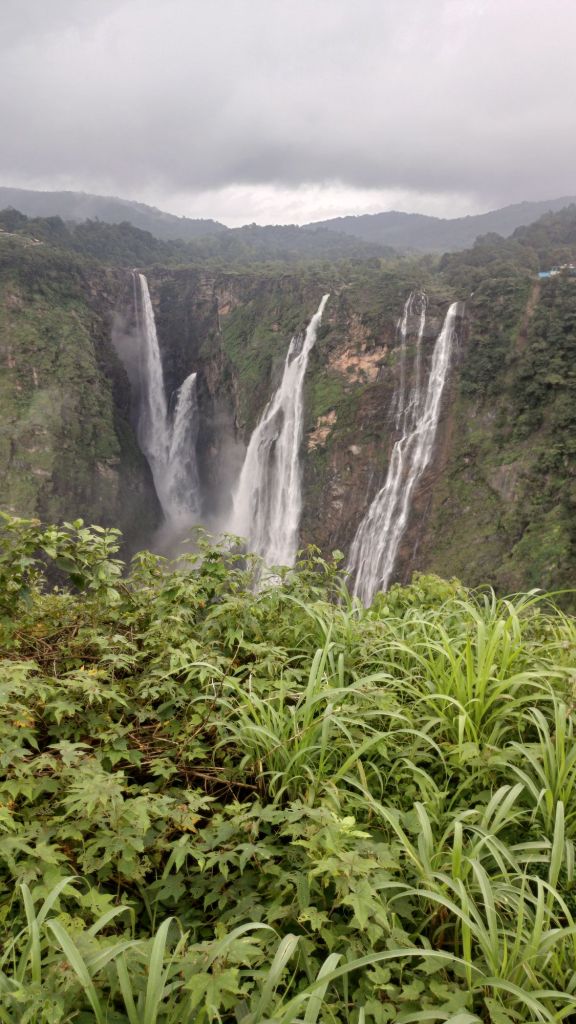
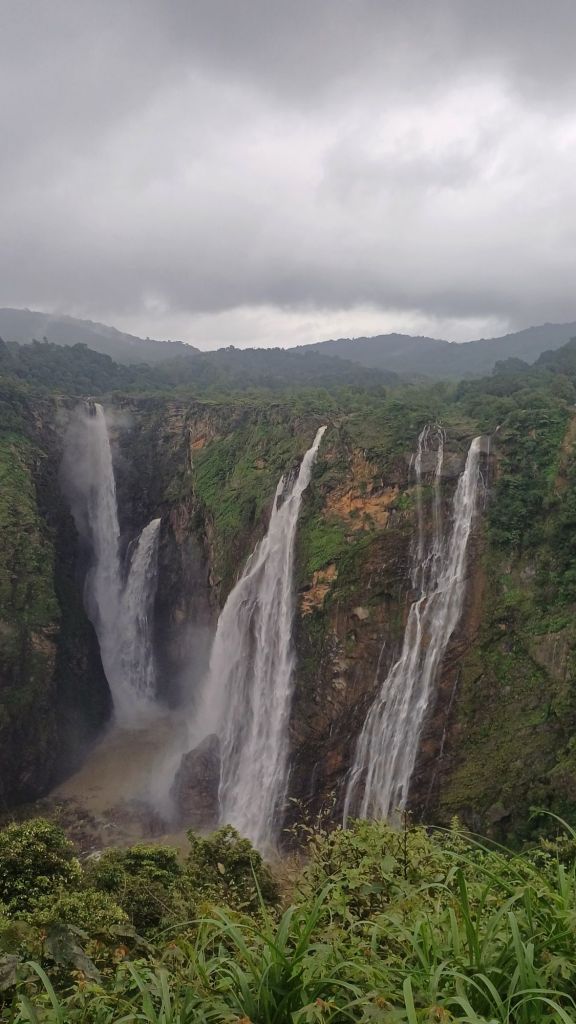
Few spectacles in Karnataka match the sheer auditory and visual scale of Jog Falls (also known locally as Gerosoppa Falls). Formed by the Sharavathi River plunging 253 meters (830 feet) straight down a jagged chasm, it is India’s second-highest plunge waterfall—and when it roars at peak capacity, you feel the vibrations deep in your chest before the mist even hits your face.
The Anatomy of the Plunge
The Sharavathi doesn’t simply spill over the cliff as a flat sheet. Instead, natural bedrock contours fracture the river into four wildly distinctive streams:
* Raja: The undisputed heavyweight. A massive, solid column of water that plunges straight into the gorge without making contact with the rock face.
* Roarer: Piercing out from a narrow cleft at a sharp angle, it collides directly with rock outcrops to produce the deafening boom that gives the falls its name.
* Rocket: Blasts out at extreme velocity through a confined chute, fragmenting into high-pressure white jets that shoot outward in bursts.
* Rani: The dancer of the four. It spirals and slips smoothly across the sloping face of the cliff in a curtain of fine, milky spray.
Timing the Run: When to Be There
Visiting Jog Falls outside the monsoon can be underwhelming, as the upstream Linganamakki Dam controls the flow for hydroelectric power generation.
* Monsoon (July to September): The only window you should prioritize. When the reservoir reaches capacity and the dam crest gates are hoisted, the valley turns into a cauldron of spray, thunder, and fleeting rainbows.
* Post-Monsoon (October to November): Ideal if you prefer clear skies and sharp photography over raw torrents. The mist clears out, letting you see the full depth of the abyss.
* Summer (March to May): Skip entirely. The falls reduce to thin streaks against the dry granite.
The Viewpoints & The 1,400-Step Descent
Most day-trippers cluster around the KSTDC Hotel Mayura complex, which sits squarely opposite the chasm. The paved galleries here provide the classic postcard angle without having to hike.
If you want a different vantage, head toward the British Inspection Bungalow near the top for a steep lookdown right at the lip where the river tips over into the void.
Trekker’s Note on the Bottom Trail: A stairway of roughly 1,400 steps leads down into the base of the gorge. When open, the sheer wind force and water spray at the bottom will soak you in seconds. However, local authorities often close the staircase during heavy torrential spells due to safety concerns and flash floods. If it is open during your visit, carry plenty of water—the descent is easy, but climbing 1,400 steps back up in humid monsoon air will test your quad strength.
Route & Highway Logistics
If you are driving in from coastal Karnataka, Goa, or inland hubs like Bengaluru, the roads winding through Shivamogga and Uttara Kannada offer some of the most scenic stretches in the state.
Route Segment | Distance & Highway | Road Condition & Driving Notes
1. Sagara to Jog Falls | ~30 km via NH 206 (NH 69) | Smooth two-lane highway with gentle curves; typically takes 40–45 mins.
2.Shivamogga to Jog Falls | ~100 km via NH 69 | Broad asphalt passing through lush farmland and towns like Anandapura.
3.Honnavar (Coast) to Jog Falls | ~60 km via NH 69 (Gersoppa Ghat) | Scenic, twisty climb through dense rainforest; watch for sharp hairpin bends in wet weather.
4. Bengaluru to Jog Falls | ~380 km via NH 48 & NH 69 | Best route: Tumakuru \rightarrow Arsikere \rightarrow Shivamogga \rightarrow Sagara \rightarrow Jog.
Nearest Railhead: Talguppa (14 km), which connects directly to Bengaluru and Mysuru via regular express trains.
Practical Travel Tips for the Trip
Fuel & Stays: The nearest major hub with reliable lodging and service stations is Sagara. Book KSTDC Mayura well in advance if you want to wake up right next to the gorge view.
Drive further inland to explore the Ikkeri Aghoreshwara Temple and the quiet backwaters around Linganamakki Dam.

